

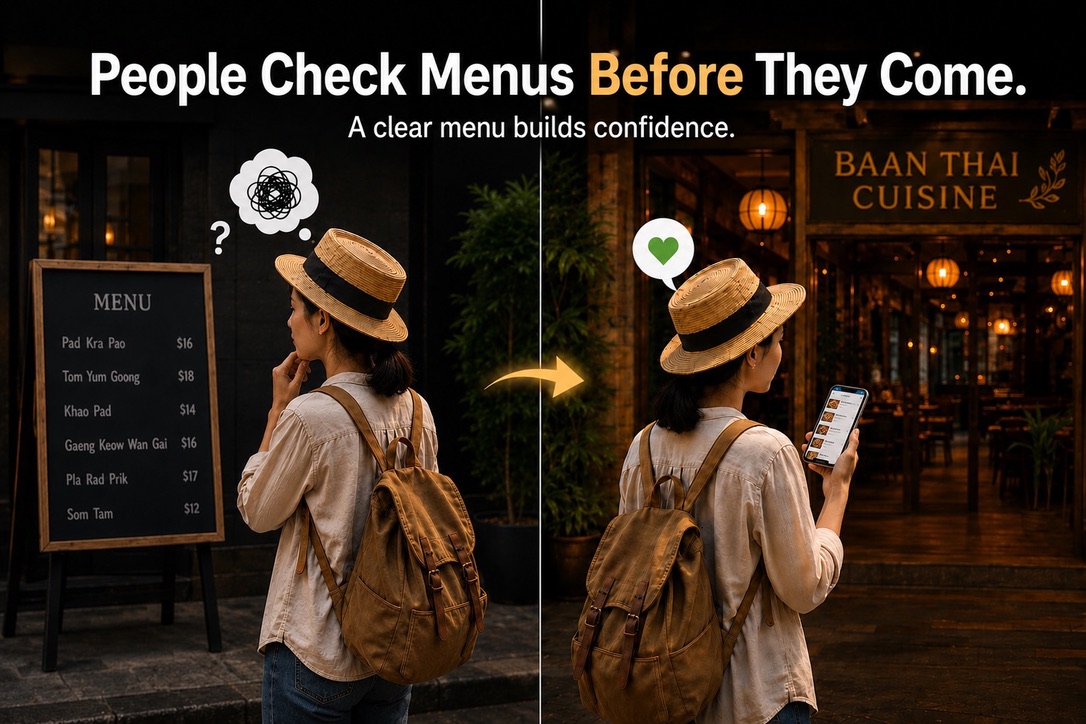
Most Restaurant Menus Don’t Help People Decide
Many restaurant owners think menus exist for one purpose: To let customers order food. But in reality, modern menus do something much bigger: They help people decide whether they feel comfortable eating at your restaurant in the first place. Especially today — when tourists, families, and first-time visitors often look at your menu online before walking in. If your menu creates confusion, hesitation, or uncertainty, many customers simply move on. Not because your food is bad, Bbcause making a decision felt too difficult.
People Don’t Just Read Menus Anymore
Customers now browse menus before they arrive.
Usually on:
- Google Maps
- Restaurant websites
- AI assistants like ChatGPT or Gemini
- Travel blogs and recommendation apps
And while browsing, they are silently asking questions like:
- What kind of food is this?
- Is this dish spicy?
- Can my kids eat here?
- What does this dish name mean?
- Is the portion big enough?
- Will I know how to order?
- Does this place feel welcoming?
Most menus never answer these questions.
Many Menus Create Uncertainty
This is especially common with:
- PDF menus
- POS-generated online menus
- Image-only menus
- Direct word-for-word translations
- Menus with no explanations or photos
For local regular customers, this may not matter much, but for tourists or first-time visitors, uncertainty becomes friction.
A dish called:
Golden Basil Blown Tube
might technically be translated correctly. But most people still have no idea what it is, and when customers don’t understand something, they usually don’t ask, they leave.
Customers Decide Emotionally Before Logically
Most restaurant owners think customers first compare prices.
Usually they don’t.
People first decide emotionally:
- Does this look good?
- Do I understand it?
- Do I feel confident ordering here?
- Will this experience feel comfortable or stressful?
That feeling matters more than many restaurants realize, especially for unfamiliar cuisines. Confidence to order is one of the biggest hidden factors behind customer conversion. A clear menu reduces hesitation, a confusing menu increases anxiety.
Your Menu Is Part of Your Restaurant Experience
Many restaurants spend heavily on:
- interior design
- plating
- atmosphere
- branding
But their online menu experience feels:
- cold
- outdated
- difficult to read
- disconnected from the restaurant itself
This is why many POS-generated menus fail as “official” restaurant menus, they are built for transactions, not for helping humans decide. A menu is not just an ordering interface, it is part of the restaurant experience itself.
In the AI Era, Menus Are Becoming Recommendation Data
This becomes even more important as AI assistants increasingly recommend restaurants to users.
AI systems now try to understand:
- cuisine types
- signature dishes
- customer preferences
- dietary restrictions
- atmosphere
- specialties
But if a menu is:
- poorly structured
- image-only
- missing descriptions
- difficult to parse
then both humans and AI struggle to understand the restaurant properly.
Modern menus now have two audiences:
- Humans
- AI systems
And both need clarity.
A Good Menu Doesn’t Just Show Food
It reduces hesitation. It helps customers feel:
- comfortable
- curious
- confident
- ready to order
That is why modern menus need more than simple digitization.
They need:
- better structure
- visual clarity
- multilingual explanations
- mobile-friendly layouts
- AI-readable formatting
- better dish presentation
Without losing the restaurant’s original identity and style.
At Yaami, we believe restaurant menus should help people feel confident enough to say:
Yes — let’s eat here.
Not:
I’m not sure what any of this means.