

Walk into many high-end restaurants, and you may notice something interesting:
No food photos.
Just text.
Maybe elegant typography. Maybe a minimalist layout. Maybe a carefully designed printed menu with no visuals at all.
For decades, many restaurant owners believed that food photos make menus look cheap, cluttered, or overly commercial.
And honestly?
Some of those concerns are valid.
But the internet changed how people discover restaurants. And AI may be changing what menu visuals can become.
Why Many Restaurants Hate Menu Photos
The dislike of menu photos didn’t appear out of nowhere.
Restaurant owners have real reasons.
1. Bad food photos can damage a restaurant’s image
Many menu photos look terrible:
- blurry
- oversaturated
- inconsistent lighting
- badly cropped
- outdated
- obviously fake
A bad food photo can make a dish look worse than reality.
For premium restaurants, that’s dangerous.
2. Printed menus become cluttered very quickly
Traditional menus have limited space.
Adding photos often means:
- smaller text
- crowded layouts
- visual chaos
Especially for restaurants with large menus.
Many owners would rather keep the menu clean and readable.
3. Menu items change constantly
Restaurants are not static.
Prices change. Seasonal dishes rotate. Ingredients change. Presentation changes.
Keeping food photography updated is expensive and time-consuming.
4. Some restaurants want customers to imagine the dish
This is especially common in:
- fine dining
- omakase
- tasting menus
- traditional restaurants
The philosophy is:
"The experience should speak for itself."
In some cultures, menus are intentionally minimal.
The dish arrives as a surprise.
5. Customers also dislike fake AI-generated food photos
Ironically, customers often complain about this too.
On Reddit and restaurant forums, people regularly criticize:
- fake AI food images
- unrealistic portions
- over-edited dishes
- menus that look nothing like reality
And they’re right.
If a menu becomes a gallery of fake food renders, trust disappears.
But Customer Behavior Has Changed
The problem is:
Restaurants no longer exist only inside the restaurant.
People now discover restaurants before they arrive.
On:
- Google Maps
- TikTok
- Yelp
- travel blogs
- AI assistants
- search engines
And during that process, menus become decision-making tools.
Not just ordering tools.
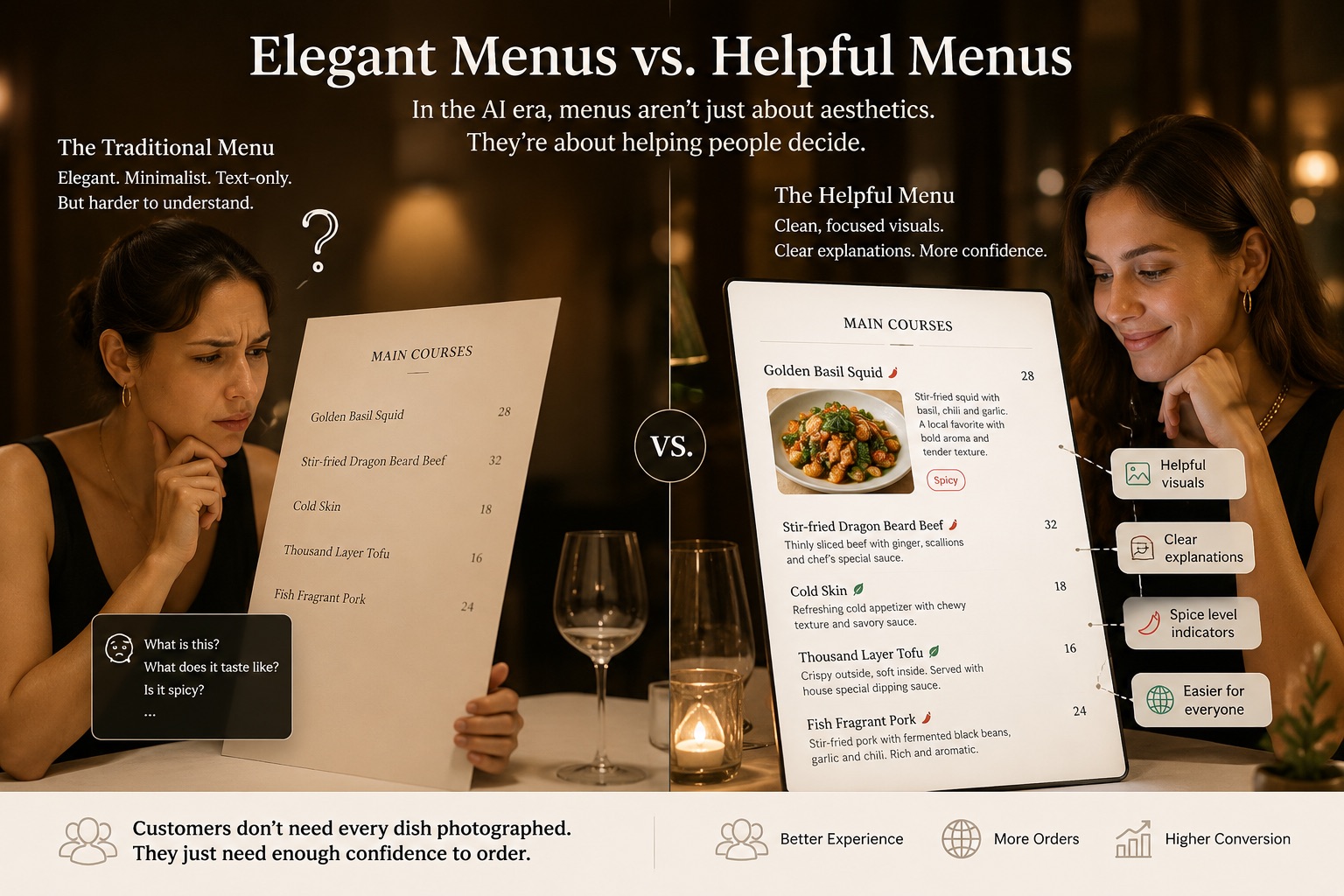
Tourists often don’t understand the menu
This becomes obvious in tourist-heavy cities.
A local customer may understand a dish name instantly.
But international visitors may have no idea what they’re looking at.
For example:
- “Golden basil squid”
- “Dragon beard beef”
- “Cold skin”
- “Fish fragrant pork”
- “Thousand layer tofu”
Even translated English names can still be confusing.
And without visuals or explanations, customers hesitate.
Many simply leave.
People don’t want to gamble on unfamiliar dishes
This is especially true online.
When browsing menus on a phone, customers make decisions very quickly.
If they cannot understand a dish within seconds, they often move on.
Not because the restaurant is bad.
Because uncertainty creates friction.
A menu today is not only about listing dishes.
It’s about reducing hesitation.
The Old Debate About Menu Photos May No Longer Apply
Here’s what changed:
In the past, menu photos meant:
- low-quality printed pictures
- static layouts
- expensive photography
- cluttered design
But AI changes the equation.
Modern menu visuals don’t have to look cheap
Today, menus can use:
- selective visuals
- AI-enhanced dish photos
- dynamic layouts
- contextual dish explanations
- responsive mobile design
- interactive viewing experiences
Most importantly:
Not every dish needs a photo.
That’s the key difference.
Customers don’t need every dish photographed
They just need enough confidence to order.
That confidence can come from:
- one helpful image
- a short explanation
- ingredient clarification
- spice indicators
- texture descriptions
- serving style previews
The future of menus is probably not:
A giant menu filled with photos.
The future is:
Menus that reveal visuals only when visuals help decision-making.
AI Is Changing the Purpose of Menu Visuals
This is the deeper shift happening now.
Food photos are no longer just decoration.
They are becoming:
- navigation tools
- trust-building tools
- tourist assistance tools
- AI-readable signals
- recommendation context
This matters because AI assistants are starting to read restaurant menus too.
And AI systems struggle with:
- scanned PDFs
- blurry images
- untranslated dish names
- inconsistent formatting
- text-heavy menus with no context
Menus are no longer being read only by humans.
Now they are also read by machines.
The Best Menus Will Probably Combine Both Worlds
The best restaurant menus in the future may not be:
- fully visual
- fully text-only
- fully AI-generated
Instead, they may combine:
- the personality of traditional menus
- the clarity of modern interfaces
- selective visual assistance
- multilingual explanations
- AI-friendly structure
Without losing the restaurant’s identity.
This Is Why Yaami Exists
At Yaami, we don’t believe restaurant menus should become generic AI-generated templates.
We believe menus already contain personality.
The goal is not to replace that personality.
The goal is to help more people understand it.
Especially:
- tourists
- international diners
- mobile users
- first-time visitors
- AI discovery systems
A menu can still feel elegant. Still feel local. Still feel authentic.
While also becoming easier to understand in the AI era.