

AI is becoming your first customer touchpoint
Not literally.
But increasingly, tools like ChatGPT, Google, and voice assistants are acting as the first layer of decision-making.
People don’t just search anymore.
They ask:
Where should I eat nearby? What’s good here? Do they have vegetarian options?
And AI tries to answer.
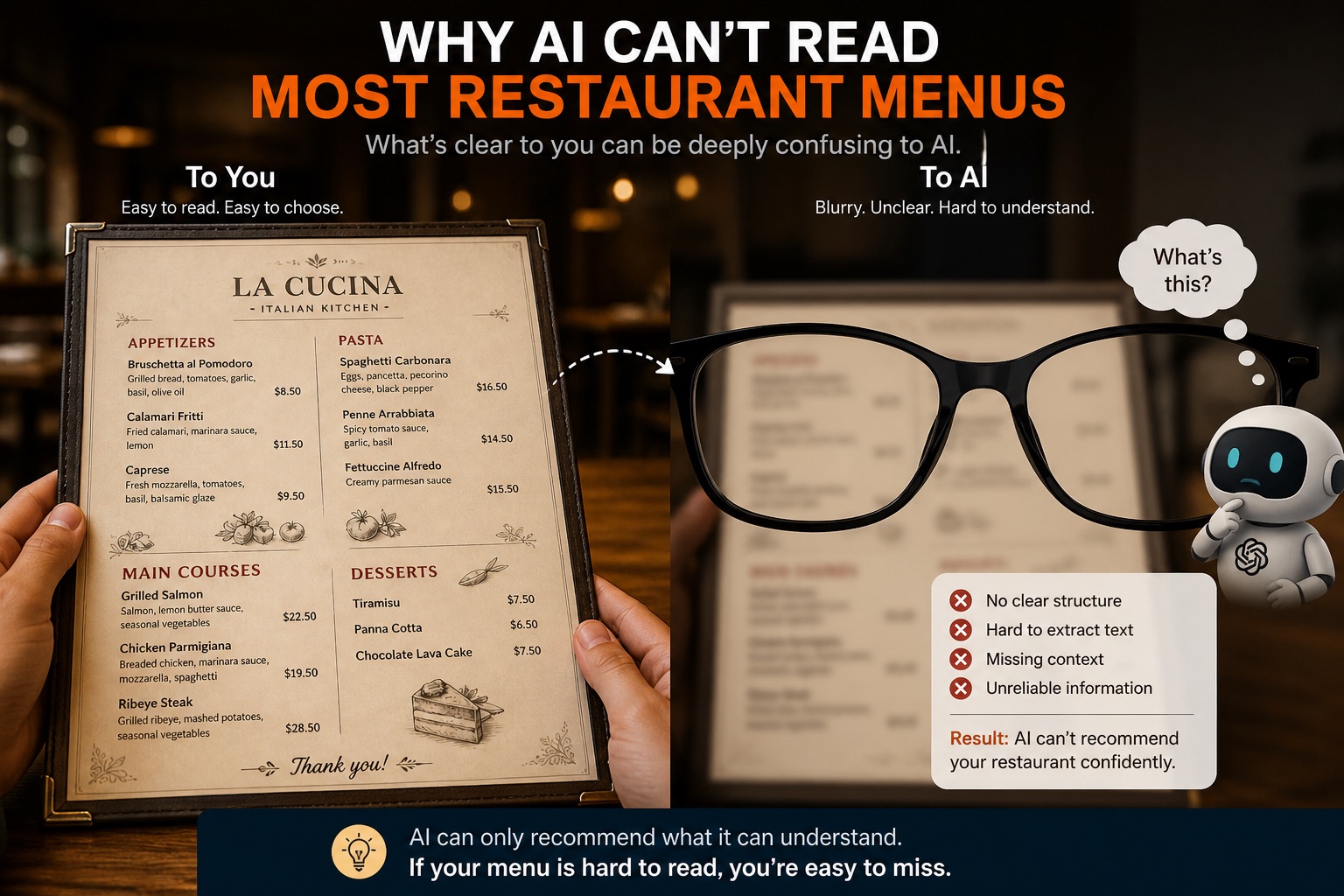
The problem: most menus are unreadable to AI
Most restaurant menus do exist online.
But they are not readable in a meaningful way.
To humans, they look fine.
To AI systems, they are fragmented, ambiguous, or invisible.
The illusion of “having a menu online”
Many restaurants believe:
We already have our menu online.
And they’re not wrong.
They typically have:
- A PDF menu on their website
- Photos uploaded to Google Maps
- A POS-powered ordering page
These formats work for humans.
But they don’t work well for AI.
Why AI struggles with restaurant menus
1. PDFs are visual, not structured
A well-designed PDF looks clean and organized.
But to AI, it often appears as blocks of text without clear hierarchy or relationships.
In many cases, PDFs are actually just images inside a file.
So instead of understanding dish name, description, and price, AI is essentially looking at pixels.
2. Menu photos are even harder
Menu photos introduce additional complexity:
- Lighting issues and shadows
- Decorative or inconsistent fonts
- Overlapping text and images
- Cropped or distorted layouts
Humans can guess meaning from context.
AI systems struggle to do that reliably.
3. POS menus are structured — but not accessible
POS systems do contain structured data.
But that data is:
- Locked behind interfaces
- Designed for transactions, not understanding
- Missing descriptive context for dishes
As discussed in Online Ordering Is Not Your Menu, these systems are optimized for ordering, not for helping people discover what to eat.
4. Missing semantic meaning
Even when the text is readable, the meaning is often unclear.
For example:
Dragon Roll
To a human, this suggests a type of sushi.
To AI, it could mean many different things — or nothing at all.
Without context, AI cannot confidently interpret or recommend it.
Two different readers now exist
Restaurants are no longer serving just one audience.
There are now two:
Humans
They browse visually and interpret intuitively.
AI systems
They extract, structure, and recommend.
And this is the key shift:
A menu that works for humans
does not automatically work for AI.
What happens when AI can’t read your menu?
You become harder to discover.
Especially in situations like:
- AI-generated recommendations
- “Best nearby” summaries
- Voice search
- Travel planning tools
If AI cannot understand your menu, it is less likely to recommend your restaurant.
This is not about adding AI features
This is not about chatbots or automation.
It’s a more fundamental question:
Can machines understand what you offer?
The shift: from visual menus to readable menus
Menus need to evolve from something that looks good
to something that can be understood.
That means:
- Structured data
- Clear hierarchy
- Dish-level meaning
- Multilingual clarity
- Consistent formatting
Where this is going
In the near future:
- Customers won’t browse ten restaurants
- They’ll ask AI for two or three recommendations
And those recommendations will depend on one thing:
Which menus AI can actually read.
The real question
Is your menu visible to AI?
Or only visible to humans?
Explore more
- Why Most Restaurant Menus Still Don’t Work (Even Digital Ones)
- Online Ordering Is Not Your Menu
- From Photo to AI-Ready Menu in 2 Minutes (Yaami Beta)