

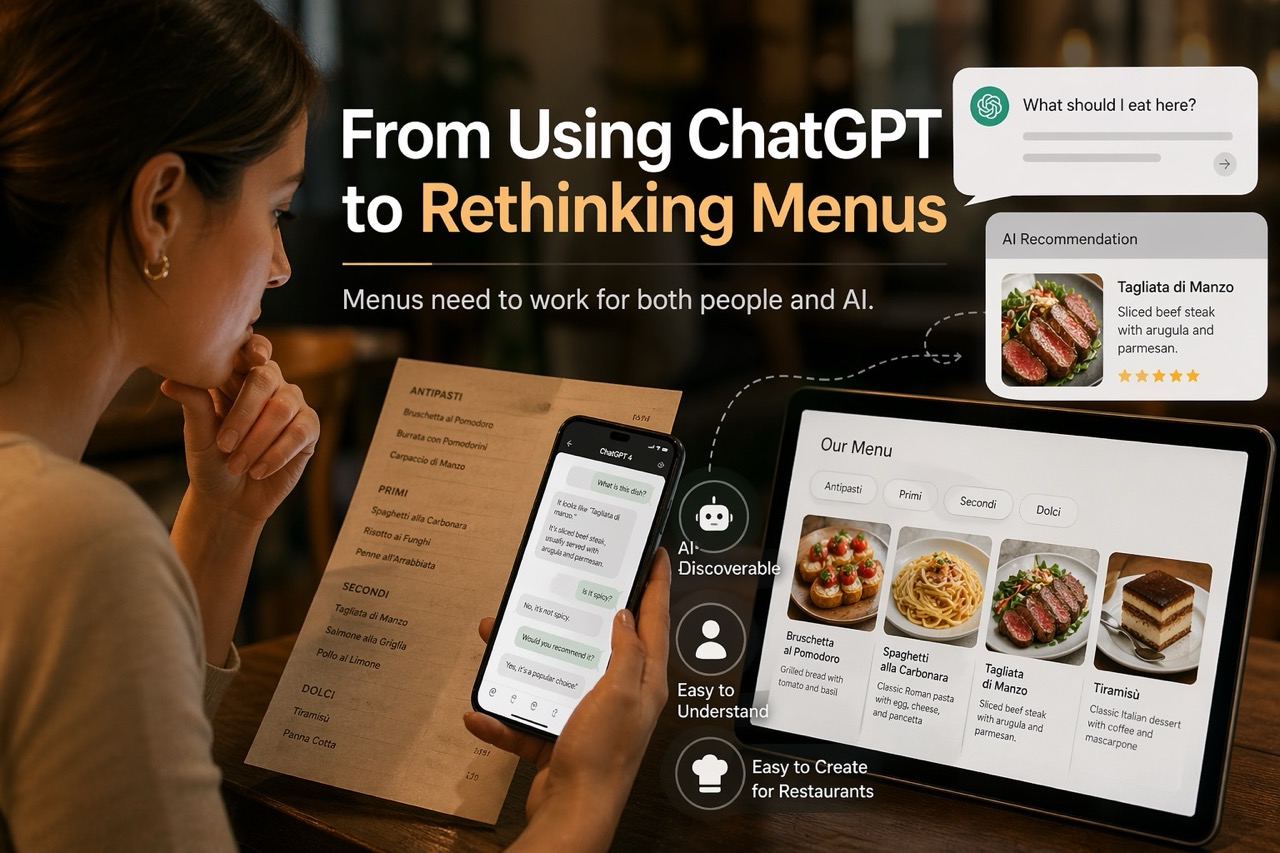
In Italy, we didn’t just struggle with menus —
we started using ChatGPT to decide what to order.
We would take photos, paste dish names, and ask questions like:
“What is this?”
“Is it beef or pork?”
“Is it safe to order?”
And surprisingly, it worked.
ChatGPT didn’t just translate the menu.
It helped us make decisions.
But something felt off
If we needed AI just to understand a menu,
something was already broken.
Menus weren’t designed for international guests.
And they definitely weren’t designed for AI.
That’s when we realized:
The problem is not language.
It’s how menus are structured, presented, and discovered.
Menus need to work with AI
Today, more and more decisions start with AI.
People ask:
- “What should I eat here?”
- “What’s popular in this restaurant?”
- “What’s a must-try dish?”
If a menu cannot be understood by AI,
it won’t be recommended.
Most restaurant menus today are:
- PDFs
- images
- or unstructured text
To AI, they are almost invisible.
If your menu isn’t AI-readable,
it’s not part of the decision process anymore.
Menus need to be understood instantly
Even when translated, menus are still hard to understand.
Dish names alone don’t help people decide.
For international guests, this creates friction:
- unfamiliar ingredients
- unclear descriptions
- too much reading
People don’t want to study a menu.
They want to recognize it.
That’s why visual menus matter.
Images, simple explanations, and clear structure
help people understand dishes at a glance —
without needing to open another app.
Menus need to be easy to create
But there’s another reality.
Most restaurant owners don’t have time to:
- rewrite menus
- add detailed descriptions
- manage digital tools
They already operate under pressure.
Any solution that adds complexity
simply won’t be adopted.
A new way to think about menus
At that point, we stopped thinking about menus as static documents.
Instead, we started thinking about them as something that needs to work across three layers:
- For AI → to be discovered and recommended
- For people → to be understood instantly
- For restaurant owners → to be created effortlessly
This also led us to rethink one key element:
Menus should be visual-first.
Not just translated,
but restructured into something intuitive, recognizable, and aligned with how people actually choose food.
Where Yaami begins
We didn’t want people to rely on ChatGPT to understand menus.
We wanted menus that didn’t need ChatGPT at all.
At the same time, we wanted those menus
to be discoverable and usable by AI.
And we wanted restaurant owners
to create them without friction.
That idea became the starting point of Yaami.
Not just a tool to digitize menus —
but a new way to make menus work
for both humans and AI.